

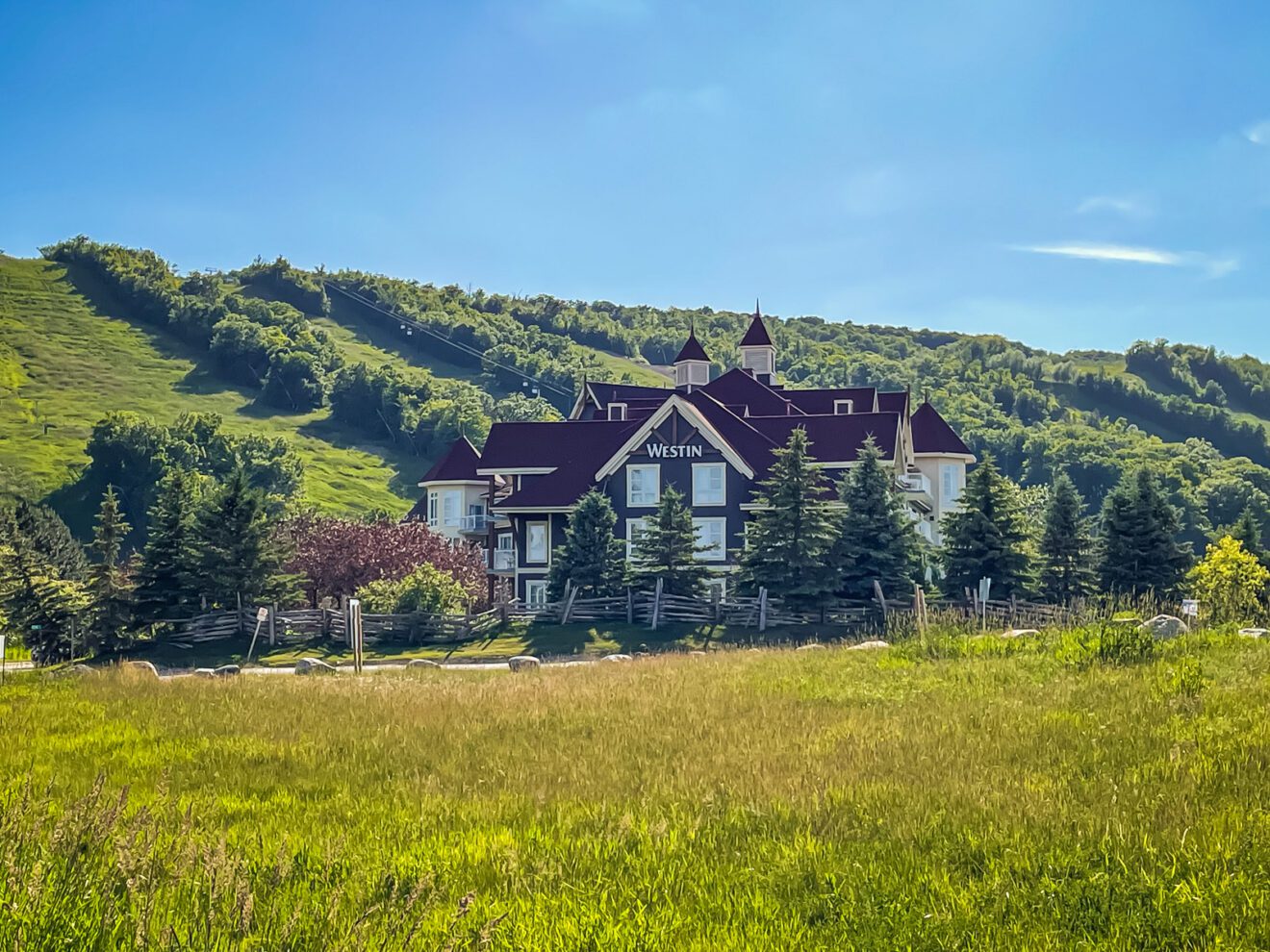
The Blue Mountains, Ontario | Reviewed November 2, 2026
A Blue Mountain vacation property can be a good investment—but the answer depends on the property, your financing and how you want to use it. A home that works well as a family getaway may not deliver the rental cash flow you need. A property with appealing gross bookings can still require regular contributions from your household budget.
The key is to separate three things: the rental business, the equity you build and the personal value of having a place here. All can matter to your decision, but they aren’t interchangeable.
If you’re exploring a Blue Mountain vacation property investment, start with the costs and permissions behind the listing, not just the advertised nightly rate. Here’s how to work through the numbers without assuming the property will pay for itself—or that it needs to be a purely financial purchase to be worthwhile.
What would make it a good investment for you?
Before comparing properties, decide what you want the purchase to do.
If you’re buying mainly for income, the priority is dependable cash flow after operating costs and financing. If you’re buying mainly for your own visits, the question may be whether permitted rentals can offset part of a carrying cost you’re comfortable paying. If you’re hoping for both, put your own travel plans into the budget from the beginning.
There’s nothing wrong with valuing a four-season home base. The important part is being honest about the trade-off. Personal enjoyment isn’t rental income, and a future resale gain isn’t money available to pay this year’s bills.
A useful starting question is: “Would I still be comfortable owning this property if rental revenue disappointed and its value didn’t rise?”
Why Blue Mountain’s lifestyle appeal isn’t a rental forecast
Blue Mountain offers skiing and other seasonal recreation, alongside Village activities and events. That gives buyers several reasons to enjoy a property through the year. [1]
For a rental budget, however, look at individual months and dates. Don’t apply a holiday asking rate to every available night. Ask how weekends, midweek stays, seasonal changes and time unavailable for bookings affect the actual property.
A nightly rate you see online is an asking price for a particular stay. It isn’t proof of the rate an owner achieved across the year. Likewise, a calendar with blocked dates doesn’t tell you whether those nights were paid bookings, owner stays or maintenance closures.
Request the unit’s completed booking records and owner statements, ideally covering more than one full year where available. Then reconcile the revenue with cancellations, discounts, management deductions and the dates you plan to keep for yourself.
Confirm rental permission before relying on rental income
A location near Blue Mountain doesn’t automatically make a property rentable. Start with the actual municipal address and the permitted use.
Within the Town of The Blue Mountains, the approval framework distinguishes Short-Term Accommodation, or STA, from Commercial Resort Unit, or CRU, use. Obtain written confirmation of the unit’s classification and the buyer’s approval path. Separately review the condominium documents and any rental-management agreement. [2]
New Type B STA licences outside the exception zone remain under a moratorium, although existing Type B licences may renew. A Town-issued licence is not transferable from the seller to the buyer. Don’t treat a seller’s operating history as permission to continue unchanged after closing. [2]
For a managed resort property, check who can market the unit, how your own stays are booked and what standards or refurbishment obligations apply. Those terms can change both your flexibility and the income available to you. They aren’t identical across every resort-area condo.
If rental income is essential to making the purchase affordable, eligibility needs to be established before that income becomes part of your decision.
Gross rent, operating surplus and cash flow are different numbers
Gross accommodation revenue
Gross accommodation revenue is the amount earned from paid stays before operating expenses. Keep guest taxes and separately reimbursed pass-through charges out of the investment-income figure you’re using.
The Blue Mountains’ 4% Municipal Accommodation Tax, or MAT, applies to relevant transient stays under 30 days, including STA and CRU accommodation. Visitors pay it through the accommodation provider; collected tax isn’t owner profit. [4]
Operating surplus
From accommodation revenue, subtract the costs of operating the property. These may include management and booking charges, unreimbursed turnover costs, condominium expenses, property tax, insurance, utilities and other applicable obligations.
The amount left before financing is useful for comparing the rental operation. It doesn’t yet tell you what remains after a mortgage, replacement savings or income tax.
Cash flow after financing
For your household budget, subtract the full scheduled mortgage payment, not just its interest portion. If you also set aside money for furniture and replacements, show that separately.
The result tells you whether the rental operation supplies cash or requires you to contribute it under those assumptions. It isn’t the same as taxable income or total investment return.
Mortgage principal isn’t an income-tax deduction. Repaying it reduces debt, but that equity isn’t spendable rental cash. [5]
Build the expense budget from the actual property
Condominium costs, repairs and replacements
For a condo, review what common-expense fees include and what remains yours to pay. Reserve-fund contributions are already a use of those fees, so don’t automatically add them again as a second recurring bill. [6]
Review the budget, audited statements, reserve-fund information and disclosed assessments with your lawyer. A reserve fund helps plan for major work; it doesn’t guarantee no future fee increase or special assessment. [6]
Keep a separate allowance for your own furniture, equipment or replacements where appropriate. That isn’t the same as a corporation’s reserve contribution. For a detached vacation home, replace the condo-fee assumption with its actual maintenance and servicing responsibilities.
Village membership and rental-related charges
Blue Mountain Village Association, or BMVA, charges apply to identified member properties—not every vacation property in The Blue Mountains. Obtain the current BMVA status-certificate package for the property you’re considering. [8]
The published January 2026 schedule lists purchase Entry Fees of 2% plus HST for Village Core member properties and 0.5% plus HST for Non-Core member properties. Published annual Basic Fees are $1.16 or $0.29 plus HST per above-grade square foot, respectively. Confirm current charges rather than treating that reference schedule as a guaranteed closing quote. [9]
The same guide lists a 2% plus HST Village Amenity Fee, also called a Rental Royalty, on gross long- and short-term rental revenue. Importantly, it states that this fee has been collected as part of the 4% MAT since January 2025. Don’t automatically stack another 2% expense on top of guest MAT. Confirm the actual collection, HST treatment and any owner-borne amount in the property’s statements and current BMVA arrangements. The guide’s long-term rental wording doesn’t extend the Town’s under-30-day MAT scope. [4]
The budgeting principle is straightforward: count each actual owner expense once, and don’t count collected guest tax as earnings.
Insurance and management
Obtain an insurance quote for your intended personal and rental use. A condominium corporation’s policy doesn’t automatically cover your belongings, improvements or every deductible exposure. [10]
Read the management agreement alongside actual owner statements. Check commissions, booking charges, housekeeping, repairs, owner-stay charges and refurbishment responsibilities. A full-service operator can reduce your day-to-day involvement, but those services still need to be reflected in the numbers.
Self-management also has a cost: your time. If your model assigns no value to handling enquiries, guest issues and maintenance coordination, recognise that when comparing it with more passive alternatives.
A realistic financial example: positive operations, negative cash flow
The following is a hypothetical teaching example, not a listing, local average, lender quote or forecast. Every nightly rate, booking count and expense allowance is an assumption to replace with property-specific evidence. All amounts are Canadian dollars.
Assume a $700,000 full-ownership residential vacation condo, independently managed, with confirmed rental eligibility and BMVA Non-Core membership. This is not a universal condominium-hotel operating model.
The financing assumption is $210,000 down and a $490,000 mortgage, at an assumed 5% nominal fixed rate, compounded semi-annually, with 25-year amortization. The calculated monthly payment is $2,849.86, or $34,198.32 annually. The assumed terms must be confirmed for the actual property.
Step 1: Calculate accommodation revenue
Assume 180 paid nights at an average accommodation rate of $350. That produces $63,000 annual accommodation revenue, excluding guest taxes and separately reimbursed pass-through charges.
These are paid nights, not all nights the property is available. Any personal stays or closures should already be excluded when estimating paid nights.
Step 2: Deduct operating costs
Use an all-in variable-cost allowance of 30% of accommodation revenue, or $18,900. This is a teaching allowance for management, booking charges and net unreimbursed turnover or consumable costs, including any applicable owner-borne rental charge. It isn’t a quoted management commission. Guest MAT and other pass-through taxes are excluded from both revenue and remittances, rather than deducted twice.
Assume $21,000 in annual fixed operating costs for separately payable condo expenses, tax, rental-use insurance, utilities, applicable BMVA Basic Fees and an annualised allowance for applicable licensing or compliance. No charge already included in another bill is added again.
That leaves $23,100 before financing, personal replacement savings and income tax.
Dividing that surplus by the $700,000 purchase price gives 3.3%. This is a narrowly defined operating yield—not a net return on all your cash and not proof that the property pays for itself.
Step 3: Include replacement savings and the mortgage
Set aside $2,400 annually for personal replacements. The amount available before financing becomes $20,700.
After $34,198.32 in annual mortgage payments, the result is a $13,498.32 annual cash shortfall, before income tax and excluded extraordinary costs. That’s a monthly budgeting equivalent of $1,124.86.
This is the important distinction: the rental operation produces a positive surplus before financing, yet ownership still requires cash from elsewhere.
The example assumes no purchase GST/HST cost or recovery; that treatment must be resolved before using the model for a transaction. It also excludes extraordinary assessments or refurbishment, owner compensation, resale costs and income tax. Operating allowances include unrecovered tax costs; no input-tax-credit benefit is assumed. No appreciation is used to make the figures work.
Test a weaker year—and a stronger one
A base case is only a starting point. Try different paid-night and achieved-rate assumptions while keeping the financing and fixed costs visible.
Fewer bookings and a lower rate
At 140 paid nights averaging $300, accommodation revenue falls to $42,000. Under the same 30% variable allowance and $21,000 fixed-cost assumption, the operating surplus is $8,400.
After replacement savings and the mortgage, the annual cash shortfall becomes $28,198.32, before income tax and excluded costs.
Ask whether your household could carry that year without borrowing more or being forced to sell. This is a stress test, not a promise that the result couldn’t be worse.
More bookings and a stronger rate
At 210 paid nights averaging $375, accommodation revenue is $78,750. The operating surplus becomes $34,125.
After the same replacement savings and mortgage payments, there is still a $2,473.32 annual cash shortfall before income tax and excluded costs.
These scenarios aren’t evidence that Blue Mountain properties generally lose money. They show how the outcome changes under this purchase price, financing and expense structure. A different property or capital structure needs its own calculation.
What is your break-even occupancy?
Break-even is useful when you define what you’re trying to cover.
For this example, covering fixed costs, replacement savings and scheduled mortgage payments would require approximately $82,283.31 in annual accommodation revenue, before income tax and excluded costs.
At the assumed $350 average rate and 30% variable costs, that means at least 236 whole paid nights. The calculation is:
Required paid nights = fixed costs, replacement savings and debt payments ÷ contribution per paid night.
Here, contribution per night is the assumed nightly rate after its variable costs. The calculation isn’t a prediction that those nights can be sold.
Compare the requirement with the nights genuinely available after personal visits, maintenance and any contractual restrictions. Then look at season-by-season achieved rates. An occupancy percentage based on a reduced available calendar isn’t the same as occupancy across all 365 days.
If the numbers only work with a booking schedule the property can’t realistically support, revisit the price, financing, cost structure or purchase objective.
Your initial cash commitment is more than the down payment
In the example, a fuller opening-cash budget is:
- Down payment: $210,000.
- Ontario land transfer tax on a $700,000 value of consideration: $10,475 before any refund. [11]
- Published Non-Core BMVA Entry Fee including 13% HST: $3,955, subject to current transaction confirmation. [9]
- Legal and other closing-cost allowance: $4,000.
- Furnishing and setup allowance: $10,000.
- Opening liquidity buffer: $15,000.
That is $253,430 committed, before any applicable purchase GST/HST or other unmodelled acquisition charge. The legal, setup and liquidity figures are hypothetical allowances, not local quotes. The liquidity buffer remains available cash, not a purchase expense.
The base case’s cash shortfall divided by that total cash commitment is approximately negative 5.33%, before income tax. This is a cash-flow measure after replacement savings—not total investment return. Its denominator includes the opening buffer, so state that basis rather than compare it blindly with another advertised “cash-on-cash” figure.
For a cash purchase under the same acquisition assumptions, the opening commitment would instead be $743,430, including that buffer. With no mortgage and the same base operations, $20,700 would remain annually after replacement savings and before income tax—about 2.78% of that cash commitment.
Debt-free ownership changes cash flow, but also commits much more capital. Compare the resulting return, risk and liquidity with what else that money could do for you.
Personal use has a financial trade-off
Your own visits can be a major reason to buy. Include them honestly instead of treating them as nights the property can also earn rent.
As a separate illustration, suppose you reserve 20 nights that could otherwise have sold at $450 each. If every one would have booked, the foregone accommodation revenue would be $9,000. With the same 30% variable-cost assumption, the contribution foregone after avoided variable expenses would be $6,300.
Those bookings aren’t guaranteed, and this figure shouldn’t be deducted again from a scenario whose paid nights already exclude your visits. It’s simply a way to think about the opportunity cost of choosing potentially rentable dates for yourself.
Also check owner-booking procedures and personal-stay costs in the actual agreement. If using the property when you want is the priority, choose an ownership arrangement that supports it—even if that means less rental income.
Mortgage paydown isn’t the same as profit
In the example’s first year, scheduled payments reduce mortgage principal by approximately $10,178.50. That increases your equity relative to an unchanged property value, but it doesn’t remove the cash shortfall or turn equity into money available for bills.
Principal repayment also isn’t an income-tax deduction. [5]
To understand the eventual investment result, consider cash contributions, debt reduction, purchase and sale costs, taxes and the property’s resale value together. Don’t simply add anticipated appreciation to rental revenue and call the result a guaranteed annual return.
Financing matters in the other direction, too. Using a separate 6% initial-rate assumption on the same original loan and 25-year amortization produces a $3,135.05 monthly payment. That adds $3,422.28 in annual payments compared with the 5% assumption. It is a sensitivity illustration, not a prediction of a particular future renewal.
Appreciation and resale: don’t use a future gain to solve today’s budget
The scenarios assume no price appreciation. That’s intentional: a hoped-for gain shouldn’t be needed to fund predictable carrying costs.
Prices can fall, and debt amplifies the effect on your equity. For illustration, a 5% decline on a $700,000 property is $35,000 before selling costs. That’s approximately 16.67% of the example’s original $210,000 down payment, before principal changes or tax effects. This is a leverage illustration, not a Blue Mountain price forecast.
Before buying, think about how long you could hold through a weaker rental period or resale market. Include the eventual costs of selling and discharging financing. Real estate isn’t a liquid savings account, and the timing of a sale may not match the timing you’d prefer.
Taxes and financing can change the answer
Resort-property GST/HST treatment isn’t something to infer from “resale” in a listing. Purchase, rental and personal use, the seller’s tax history and a later change in use can affect the result. Registration doesn’t automatically guarantee exemption or full purchase-tax recovery. Have an accountant and your real-estate lawyer review the transaction before committing, and consult again before changing use or selling. [13]
For income tax, separate personal expenses from rental expenses and distinguish current from capital costs. Don’t treat every cash payment as an immediate deduction. Rules also deny the non-compliant portion of otherwise deductible short-term-rental expenses when provincial or municipal permission, registration, licensing or permit requirements aren’t met. These income-tax rules are separate from GST/HST and MAT. [5]
Have the lender review the specific unit, ownership structure and rental arrangement. Condominium-hotels and rental-pool properties may not qualify for the same products as an ordinary residential second home. Canada Guaranty’s Lifestyle Advantage product, for example, excludes those property types and rental properties; that is a product rule, not a market-wide financing ban. [15]
Confirm the required down payment, permitted rental-income treatment and actual written terms rather than assume all projected gross rent will help you qualify.
When the purchase may—and may not—fit
A Blue Mountain vacation property may fit well when the rental use is confirmed, the actual costs are understood and you can carry a weaker year without financial pressure. It may also be worthwhile when personal enjoyment is the main objective and you’re comfortable treating rentals as a partial offset rather than a promise of full cost coverage.
Be more cautious when affordability depends on unverified rental permission, consistently optimistic bookings or price appreciation. A model that leaves out expenses or assumes an automatic tax benefit isn’t a sound basis for the purchase.
For an income-focused decision, compare the after-cost return and capital commitment with other choices. For a lifestyle-focused decision, compare owning with renting for the visits you genuinely expect to make. Neither comparison requires you to dismiss the appeal of having your own home base here.
Frequently asked questions
Can a Blue Mountain vacation rental pay for itself?
It can under the right property, operating and financing conditions, but don’t assume it will. Check the actual revenue and cost records, then calculate cash flow after full mortgage payments and an appropriate replacement allowance.
Is gross rental revenue a reliable measure of return?
No. Gross accommodation revenue comes before operating costs and financing. Collected guest taxes aren’t profit. Compare the amount that remains after the expenses and cash commitments relevant to you. [4]
Can I use any Blue Mountain property as a short-term rental?
No. Confirm the actual municipal eligibility, STA or CRU classification, buyer approval path, condominium restrictions and operator terms. A seller’s licence is not transferable. [2]
Does buying without a mortgage make it a better investment?
It improves cash flow by removing debt payments, but requires more capital. Compare the after-cost cash return on the full amount committed, alongside liquidity and risk—not just whether the annual cash figure is positive.
Should I include appreciation in the budget?
You can consider resale possibilities in a separate analysis, but don’t rely on an unverified gain to cover annual bills. Test ownership with no appreciation and the possibility of a lower sale value.
Are personal-use weekends financially free?
No. Ownership costs continue, and visits may replace potentially rentable dates or involve owner-stay charges. Balance that trade-off with the personal value you receive, without assuming every unused night would have booked.
Let’s compare the right properties—not just the advertised returns
The best next step is a shortlist that fits your intended use, followed by a property-specific review of permissions, owner statements, costs and financing. You don’t need a perfect forecast; you need a clear view of what could make the purchase work and what you would be committing to.
Get in touch to discuss your Blue Mountain vacation-property search. We can help identify relevant properties and the documents to work through with your lawyer, accountant, lender and insurance adviser.
For the broader purchase process, read Buying a Blue Mountain vacation property: Costs, Rules and Returns. If you’re considering a condo, Buying a Blue Mountain Condo: Fees, Restrictions and Ownership Costs explains the documents and charges behind many operating assumptions. Collingwood vs. The Blue Mountains and Living in Southern Georgian Bay can help you compare the home base itself.
This guide is educational information, not a recommendation to buy a specific property, a rental forecast or a tax, legal or financing determination. Financial scenarios are hypothetical; current permissions, fees and transaction tax treatment must be confirmed for the actual purchase.
Sources
- Blue Mountain Resort — Official Website
- Town of The Blue Mountains — Short Term Accommodation Licensing
- Town of The Blue Mountains — Licensing By-law 2021-70
- Town of The Blue Mountains — Municipal Accommodation Tax
- Canada Revenue Agency — Rental Income Guide T4036
- Condominium Authority of Ontario — Common Expenses Fees
- Condominium Authority of Ontario — Status Certificates
- Blue Mountain Village Association — Buying and Selling
- Blue Mountain Village Association — Realtor Quick Reference Guide January 2026
- Condominium Authority of Ontario — Condo Insurance Coverage
- Ontario — Calculating Land Transfer Tax
- Canada Revenue Agency — GST/HST Rates
- Canada Revenue Agency — GST/HST and Vacation Properties
- Canada Revenue Agency — Non-Compliant Short-Term Rental Deductions
- Canada Guaranty — Lifestyle Advantage Second-Home Product